If you're new to making espresso at home, you might still be familiarizing yourself with all the parts and components. One critical piece of your machine is the metal filter basket that goes inside the portafilter.
Pressurized vs. non-pressurized baskets
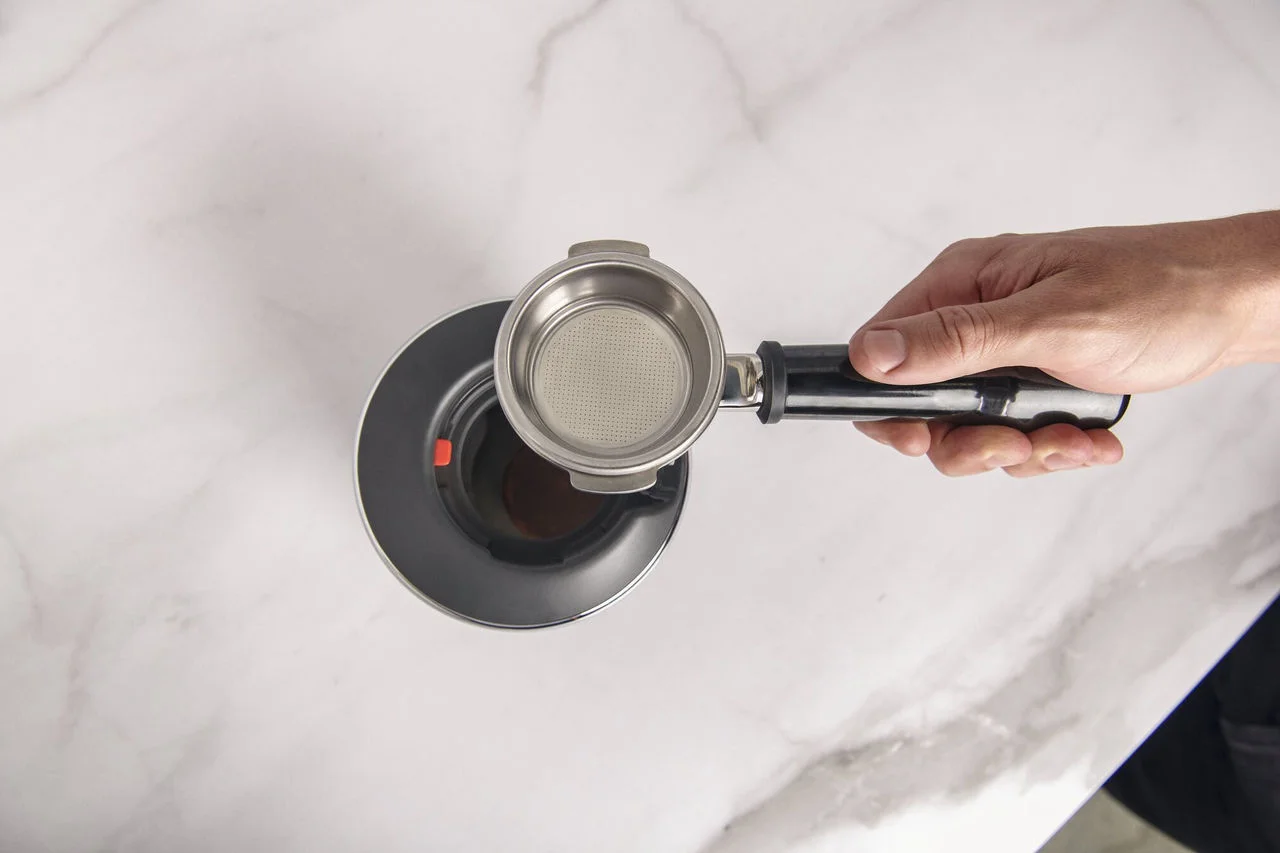
There are different types of portafilters, and some are more beginner-friendly than others. The two main categories are pressurized and non-pressurized.
Here's everything you need to know about pressurized versus non-pressurized espresso baskets, including an overview of each, who it's best for, pros and cons, and how to make the right choice for your home-brewing setup.
What is a pressurized basket?
A pressurized basket (also called a dual-wall or double-walled basket) is a metal espresso filter with an inner and outer wall. The inner wall has many holes at the bottom, and the outer wall has a single, small hole at the base. The small hole is meant to create back pressure (pressure that goes against the direction of hot water flow) during the espresso brewing process.
How it works
When brewing espresso, a double-walled basket generates back pressure by forcing hot water through the small hole at the bottom of the outer wall (like a valve). This back pressure compensates for inconsistencies that can cause issues with extraction, such as uneven espresso tamping or the wrong espresso grind size.
Key features
The key components of a pressurized basket are the two walls. One is like a regular filter basket, with lots of holes at the base. But a pressurized basket fits into an outer wall, which has just one small hole at the bottom. Some pressurized baskets have a few small holes at the base—but always much fewer than the outer piece.
Pros and cons for beginners
Pressurized portafilter baskets are generally better for beginner espresso brewers. The dual walls don't offer as much control over the espresso brewing process as a single-walled design, but the back pressure helps ensure hot water passes through the ground coffee at the right flow rate for espresso extraction.
In some cases, a double-walled basket might not produce the same full-bodied flavor as a non-pressurized option. However, it helps you achieve more consistent shots of espresso with rich crema at the top from your espresso machine.
What is a non-pressurized basket?
A non-pressurized (or single-walled basket) is a metal espresso filter with holes covering the entire base. It doesn't have the second, single-holed basket. This type of portafilter basket is used with traditional espresso machines and works with finely ground, evenly tamped coffee to create a precise, compact puck.
How it works
A single-wall basket gets the necessary pressure for espresso extraction from the puck. With many holes on the bottom, hot water can flow directly through the compressed coffee grounds. When the puck is properly tamped into a compact, even layer, it creates resistance against hot water passing through. This helps you get the optimal flow rate when brewing espresso.
What makes it different
Since you can adjust the grind size and tamping pressure, this type of portafilter basket offers more control over the espresso extraction process. Professional and seasoned home brewers can make small adjustments to ensure hot water doesn't flow through the puck too quickly, allowing for optimal extraction with more solids and the ability to fine-tune the flavor.
Pros and cons for experience users
Without a premium burr coffee grinder and experience with traditional espresso-making methods, getting the proper grind size and evenly tamping the coffee with the right amount of pressure can be challenging. But with practice, a non-pressurized basket allows for optimal extraction through enhanced control.
Besides the learning curve, a single-walled basket can be messy. Without the second wall, inconsistent tamping pressure or a grind size that's too coarse can lead to splashing or loose grounds coming out of the basket. Still, it can offer professional-quality espresso shots with perfect crema at the top.
Which espresso basket type is right for you?
When it comes to pressurized versus non-pressurized baskets for your espresso machine, the right option for you might not be ideal for the next person. Here's what to consider when choosing between the two:
● Equipment compatibility – Portafilters can often accommodate both single- and dual-wall baskets, but some espresso machines are meant to be used with just one type. Higher-end systems typically use non-pressurized baskets, while entry-level espresso machines are more likely to use pressurized baskets.
● Skill level and learning curve – Anyone can learn to use a single-walled basket with patience and practice, but it requires a certain skill level and substantial trial and error.
● Flavor and extraction differences – If you want powerful, full-bodied flavor with a rich mouthfeel and perfect crema, it might be worth learning how to use a non-pressurized basket. But if you'd rather know you're getting a good extraction, even with an imperfect grind size or tamping pressure, a pressurized basket could be a better choice.
Can you switch between the two?
In many cases, you can switch between a pressurized and non-pressurized basket. Lots of portafilters are designed for interchangeable baskets.
On days when you're short on time, you can use the pressurized basket. And when you want a more precisely extracted espresso shot, you can use finely ground coffee and focus on creating an evenly tamped puck.
What espresso basket should you get for home brewing?
If you're new to making espresso at home, you might be glad to have a pressurized basket. But as your skill level increases, you may want to upgrade to a non-pressurized basket. Or, as mentioned above, it could be nice to have both on hand.
To make third-wave specialty coffee right at home, explore Breville espresso machines and premium coffee accessories. From tamping tools and dosing funnels to naked portafilters and espresso glassware, you'll find everything you need here.
Sources:
1. Encyclopedia of Food and Health, 2016. Espresso: The Brew—Extracting for Excellence. https://www.sciencedirect.com/topics/food-science/espresso
2. Jurnal Polimesin. The effect of temperature, pressure, and grind size on Total Dissolved Solids (TDS) and extraction yield of semi-automatic espresso machines. https://www.researchgate.net/publication/382294005_The_effect_of_temperature_pressure_and_grind_size_on_Total_Dissolved_Solids_TDS_and_extraction_yield_of_semi-automatic_espresso_machines
3. Food Research International. The impact of different filter baskets, heights of perforated disc and amount of ground coffee on the extraction of organics acids and the main bioactive compounds in espresso coffee. https://www.sciencedirect.com/science/article/abs/pii/S0963996920302453
4. Matter. Systematically Improving Espresso: Insights from Mathematical Modeling and Experiment. https://www.sciencedirect.com/science/article/pii/S2590238519304102
5. Specialty Coffee Association. Defining the Ever-Changing Espresso. https://sca.coffee/sca-news/25-magazine/issue-3/defining-ever-changing-espresso-25-magazine-issue-3
6. CoffeeGeek. 6 Mistakes People Make With Their Espresso Machines. https://coffeegeek.com/blog/techniques/6-mistakes-people-make-with-their-espresso-machines/