While both cooktops provide a smooth surface and modern design, their heating mechanisms and performance vary significantly.
This guide explores the electric cooktop vs. induction difference, breaking down how each works, key advantages, and what to consider when selecting the best option for your kitchen.
How induction and electric stoves work
Understanding how these cooktops function is the first step in determining which one suits your needs. While both provide efficient heating, their methods differ significantly in speed, precision, and compatibility with cookware.
Understanding induction cooking
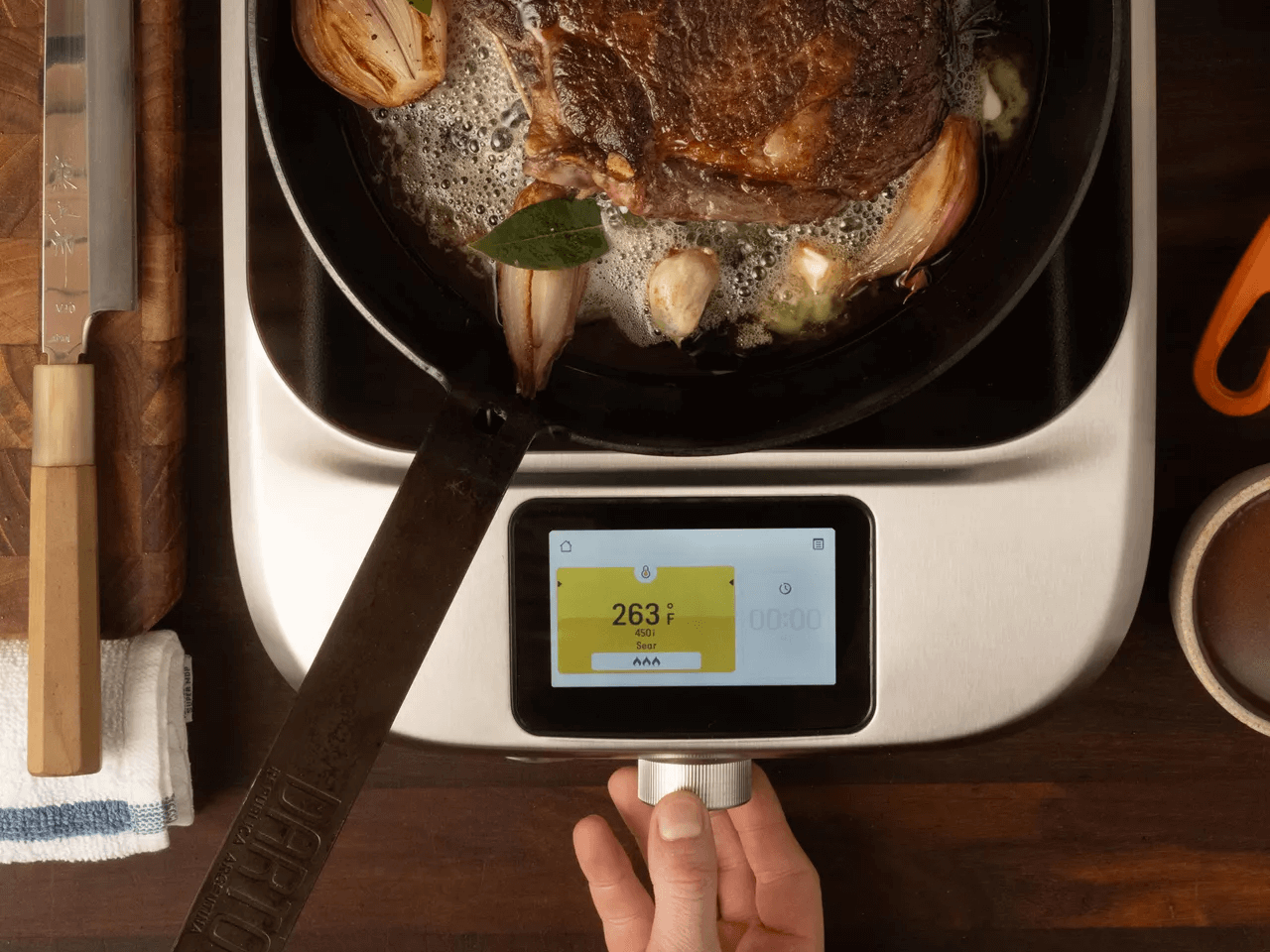
Induction cooktops use electromagnetic energy to heat compatible cookware directly.1 Instead of heating a burner, an induction cooktop generates a magnetic field that excites the metal in your pots and pans, producing heat instantly.
This process makes induction cooking highly energy efficient, reducing heat loss and offering precise temperature control. However, not all cookware is compatible. Only magnetic materials like cast iron and certain stainless steel pans will work on an induction stove.
How to check if your cookware is induction compatible
If you’re unsure whether your existing cookware works with induction, here are a few simple ways to find out:
● Use a magnet: Take a kitchen magnet and hold it to the bottom of your pan. If it sticks firmly, the pan is likely induction-compatible.
● Look for a symbol or label: Some manufacturers include an induction-compatible symbol on the bottom of the cookware, typically a coil or series of loops.
● Know which materials work best: Ferromagnetic metals such as cast iron and many stainless steel varieties are generally suitable. On the other hand, aluminum, copper, and glass cookware won’t work unless they have an added magnetic base.
● Check product details: When shopping for new cookware, look for specifications that indicate induction readiness.
Want to learn more? Read our guide onhow to use an induction cooker.
How traditional electric stoves work
Electric stoves operate using either coil or radiant heating elements beneath a smooth glass or ceramic surface.2 These elements heat up and transfer warmth to the cookware, which then cooks the food.
Compared to induction cooktops, traditional electric cooktops take longer to heat up and cool down. However, they are compatible with all types of cookware, making them a more versatile option for some kitchens.
Key differences between induction and electric stoves
While both types of stovetops can produce great results, they differ in terms of efficiency, performance, and safety. Below are the main distinctions between induction and electric stoves to consider.
Here are some of the differences between an electric and induction cooktop.
1. Energy efficiency and performance
Induction cooktops are more energy efficient because they transfer heat directly to the cookware, reducing energy waste. Electric cooktops heat the surface first, losing some energy before it reaches the pan.
Induction ranges also heat faster than electric stoves, with the ability to boil water in nearly half the time of a standard electric burner.
Because induction cooktops only heat the cookware and not the surrounding air, they also help keep the kitchen environment cooler. This is one reason why many commercial kitchens choose induction: it offers precise temperature control and a more comfortable cooking experience, especially in tight or high-heat spaces. Unlike electric or gas models, induction stoves don’t radiate excess heat into the room—just into the pan.
2. Precision and temperature control
Induction cooktops offer precise temperature control, allowing you to make fast adjustments.3 Electric coil and radiant stoves, on the other hand, take longer to heat up and cool down, making them less responsive to changes in cooking temperature.
3. Safety considerations
Safety is a key factor in the induction cooktop and electric stove debate. Induction cooking is considered the safest option because the cooktop surface doesn’t get as hot as electric or gas stoves. Additionally, since heat only activates when magnetic cookware is detected, the risk of accidental burns is minimized.
However, electric stoves also offer built-in safety features like indicator lights to show when the surface is still hot, preventing accidental contact.
4. Cleaning and maintenance
Both induction and electric cooktops offer a smooth glass surface, making cleanup easier than with a gas stove. However, one difference is that an induction stove has an advantage since spills don’t burn onto the stovetop surface, as the surrounding area remains cool.
Pros and cons of induction vs. electric stoves
Each cooktop has its own strengths and limitations. Understanding the pros and cons of each will help you decide which option best suits your cooking style and preferences.
Pros and cons of induction stoves
Induction cooktops offer advanced features that make cooking faster and more precise. However, they also come with a few trade-offs to consider.
Pros:
● Energy efficient, with minimal heat loss
● Heats quickly and provides precise temperature control
● Safer to touch after cooking
● Easier to clean due to a cooler surface
Cons:
● Requires magnetic cookware to function
● Generally more expensive upfront
● Limited availability compared to electric stoves
Pros and cons of electric stoves
Electric cooktops are reliable, widely available, and compatible with most cookware. However, they may not be as energy efficient as induction ranges.
Pros:
● Works with all types of cookware
● More affordable than induction ranges
● Even heating with modern radiant models
Cons:
● Slower temperature adjustments compared to induction
● Less energy efficient, with heat loss through the surface
● Spills can burn onto the stovetop, requiring extra cleaning
Cost comparison: Which is more affordable?
When considering the price, induction stoves tend to be more expensive upfront than electric cooktops, but they offer long-term energy savings. Electric stoves are more budget-friendly, with lower initial costs and broader compatibility with existing cookware.
Factors that affect the overall cost include:
● Appliances with advanced features (e.g., smart settings)
● The need to purchase new cookware that is compatible with induction cooking
● Energy consumption over time
Choosing the right stove for your kitchen
Your kitchen layout, cooking habits, and budget all play a role in deciding between an induction stove and an electric stove. Choose an induction cooktop if you prioritize energy efficiency, precision temperature control, and a modern, easy-to-clean cooktop surface. But if you need a more affordable option that works with all cookware and requires no special adjustments, opt for an electric stove.
Both options provide excellent performance, but understanding the electric cooktop vs. induction difference helps you make the best decision for your home.
Looking to upgrade your kitchen with an energy-efficient, high-performance induction cooktop? Explore Breville’s induction cooker for a sleek, modern solution designed for precision and ease of use.
Sources:
1. One5C. A beginner’s guide to induction cooktops. https://one5c.com/induction-cooktop-136966450/
2. ACT Government. Cooking with electricity – a guide to electric stove tops. https://www.climatechoices.act.gov.au/policy-programs/sustainable-household-scheme/buyers-guides/cooking-with-electricity-a-guide-to-electric-stove-tops
3. New York Times. Is an Induction Stove for You? Here Are the Pros and Cons. https://www.nytimes.com/wirecutter/blog/is-an-induction-stove-for-you/