There’s no denying the appeal of a traditional gas cooktop—the rush of warmth as the flame lights, the familiar heat of an open flame dancing to the tune of a screaming hot skillet.
At the same time, induction technology is gaining momentum in kitchens everywhere. From ultra-easy cleaning of the glass-ceramic finish to a cooktop that stays cool even as it brings water to a boil in mere moments, induction ranges present an appealing option.
So, which one is better? Maybe the real question is: which one is better for you?
Overview of cooking technologies
Both induction and gas cooktops ultimately have a single purpose: cooking food. The specifics of how they do that are what set them apart:
● Induction – Rather than relying on flames or electric coils, induction burner technology uses electromagnets to produce heat directly in the cookware. This means less energy is lost as “waste heat,” the kind that tends to make kitchens stuffy.
● Gas – Whereas induction relies on electricity, gas stoves ignite propane or natural gas to create an open flame. This flame then heats the pot or skillet, providing immediate visual feedback to guide the culinary experience.
What is an induction cooktop?
Sleek, minimalist elegance meets modern culinary technology with an induction cooktop.
So, how do you use an induction cooktop exactly? These kitchen appliances are relatively new to the kitchen scene, using advanced electromagnetic fields to generate heat directly in the induction-compatible cookware. The process works like this:
● An electric current passes through a coil beneath the cooking surface, creating a magnetic field.
● When a ferromagnetic pot or pan (such as cast iron or stainless steel) is placed on the cooking surface, the magnetic field generates electric currents within the compatible cookware itself.
● These electric currents quickly generate heat due to the resistance of the cookware material.
One of the most significant advantages of induction cooking is its efficiency. Because the heat is produced directly in the cookware, there is minimal heat loss to the surrounding air or cooktop surface. This results in faster cooking times—and a cooler kitchen environment.
What is a gas cooktop?
A kitchen classic, gas cooktops burn natural gas or propane to ignite a fire that then heats up the cookware. This direct heating method, adjustable by simple knobs, has made gas appliances the go-to choice for decades.
While they require mindful use to ensure safety, their effectiveness and reliability make them popular among cooks who appreciate the tactile and responsive nature of cooking over a live flame.
Comparing induction and gas cooktops
Now that we have a better understanding of both kitchen appliances, let’s compare them in three key areas: energy use, temperature control, and safety.
#1 Efficiency and energy use
Induction cooktops are generally more energy-efficient than gas stoves. Since the heat is generated directly in the induction cookware, minimal energy is lost to the surrounding air or surfaces. In contrast, gas stoves lose a significant amount of energy as heat. Some estimates place this “heat waste” as accounting for 60% of the total energy expenditure for gas stovetops.
#2 Temperature control
For both induction and gas cooktops, it takes time and experience to learn how to achieve (and maintain) the right temperature while cooking. That’s part of the art.
Even so, a gas cooktop introduces challenges:
● Temperature must be gauged through sight and sound, meaning it can be difficult to achieve consistent results
● Gas ranges tend to run hot, which is especially problematic for delicate sauces or tender ingredients
Induction cookers, on the other hand, offer excellent temperature control. From gentle simmers to intensive deep-fries, induction ranges enable accurate, steady temperatures throughout the entire process.
The level of precision an induction range offers will vary based on your chosen model. Some ranges only offer a handful of preset temperatures, whereas advanced models let you dial to the exact degree for reliable results with every meal.
#3 Safety
Induction ranges have a clear safety advantage, if only because they remove two dangerous elements from the cooking equation: open flames and a hot surface. With a gas stovetop, not only can the hot cookware burn you, but so can the grill, grates, and surrounding surface area.
Recent studies also indicate that gas stovetops are a leading cause of poor indoor air quality, which can negatively impact your health. They also introduce the risk of gas leaks due to improper installation or maintenance.
These factors point to induction electric cooktops as the safer option.
Advantages and disadvantages of each type
We’ve covered quite a bit in this induction cooktop vs. gas stove discussion, so let’s focus on the pros and cons.
To start, consider the advantages of an induction cooktop:
● Energy-efficient – The US Department of Energy estimates that induction electric cooktops are up to three times more efficient than their gas counterparts, saving on energy costs over time.
● Precise control – Induction ranges offer greater control and consistency over the heating element, enabling adjustments with rapid precision and more predictable results.
● Safer – The cool cooking surface, absence of open flame, and use of electricity instead of gas means induction is less dangerous overall.
● Easy to clean – With a smooth, glassy surface, induction ranges make cleaning up spills a cinch.
● Faster cooking – On average, induction cooktops can bring water to a boil 20% to 40% faster than gas, saving you valuable time in the kitchen.
Of course, for all of the advantages it offers, induction isn’t perfect. There are some cons as well, such as:
● Requires compatible cookware – Materials like glass and copper won’t work with an induction appliance, meaning you might need to purchase some new pots and pans and find more induction-compatible cookware. Further, irregularly shaped cookware (like a wok or a pot with a rounded bottom) may not work with an induction range.
● Higher upfront cost – Induction appliances have historically been more expensive than gas. While this still holds true, prices have dropped significantly as induction gains more acceptance.
● Noise – The noise level will vary by model, but some people report a small buzzing noise while operating an induction stovetop. While this is a normal result of electromagnetism causing vibrations, it could still be bothersome.
How about for the gas stove? While not as advanced as induction, gas ranges nonetheless boast some key advantages, such as:
● Versatility – Gas stoves can be used with any cookware, including non-magnetic materials like copper or stoneware. While it isn’t recommended, the open flame does allow for cooking techniques such as directly char-grilling food.
● Lower upfront cost – Until induction appliances catch up, gas stoves remain the economical option in terms of upfront cost. They also do not require special cookware, meaning you don’t need to invest in a new set of magnetic skillets.
● Familiarity – Perhaps the biggest advantage of a gas stove top is that most people know how to use one, whereas swapping to induction technology may seem intimidating or overwhelming at first.
For traditionalists, it’s hard to top the feeling of cooking with gas. But as with any technology used for a long time, the flaws have gradually revealed themselves.
Gas ranges suffer from several disadvantages:
● Inefficient energy use – For the energy-conscious home chef, a gas range often leaves a bigger carbon footprint since it releases more than half of the energy it uses as heat.
● Potential safety risks – Besides risks of burns and fire, the attached gas lines could also pose a safety hazard.
● Harder to clean – We’ve all spent elbow grease cleaning up a burnt-on stain. Hot grates and burners further complicate this, turning spilled chili into a clean-up headache.
● Needs proper ventilation – As mentioned, gas stoves release fumes while in use. Your home kitchen needs to be properly ventilated to prevent this from becoming a health hazard in its own right.
Clearly, both appliances have quite a few pros and cons to consider. And that leads us to our final question.
Which cooktop is best for your kitchen?
With everything said and done, one topic remains. In the great induction cooktop vs. gas stove debate, which one is right for you? While the answer to that question is yours alone, here are a few final considerations:
● If energy efficiency, rapid heating, or easy cleaning are your priorities, an induction cooktop is the ideal choice.
● If you prefer the traditional cooking experience and the versatility to use any cookware, a gas stove might be more suitable.
● For those with safety concerns, such as families with young children, induction appliances offer enhanced safety.
● Budget-conscious consumers might choose gas stoves due to their lower upfront cost or induction if they prefer long—term savings.
Of course, there are practical considerations as well. Your kitchen’s layout and infrastructure also play a part, as gas stoves need a dedicated gas line. Depending on where you live, the cost of gas versus electricity may differ.
Take culinary control with Breville
So, which cooktop is best for you? Both have their pros and cons, and either one can make a fantastic meal in the hands of a dedicated home chef.
The real question is one of preference and convenience.
For home cooks who value speed, precision, and ease of cleaning, an induction cooktop stands out. Breville elevates this experience with the Control Freak, the ultimate induction burner marked as the gold standard of quality.
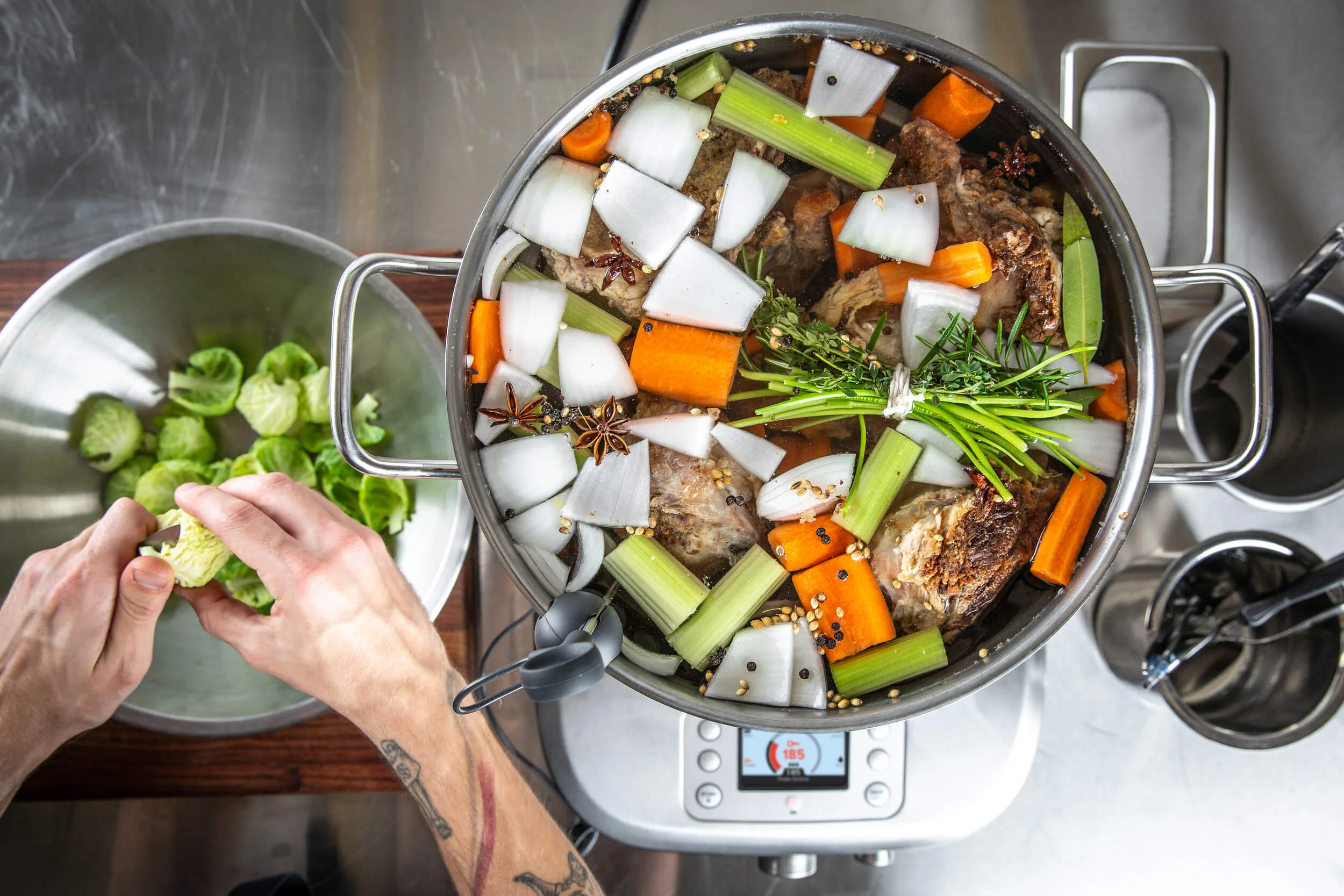
With features like a built-in probe for perfect temperature precision, presets such as “boil” or “keep warm,” and an ultra-intuitive interface, the Control Freak is perfect for anything from deep-fried dinners to sous-vide meal prep.
Or for home cooks, consider the Control Freak Home, which features the same smart induction cooking capabilities and precision control as the Control Freak, but with the added bonus of 4 cooking modes. Take control with manual mode, find the perfect temperature for your ingredients, explore techniques to dial in perfection, or build your own custom presets, all delivered on a HD touchscreen.
Why not see if an induction range is the perfect match for your kitchen? Explore Breville kitchen appliances today to find out.
Sources:
1. Explain That Stuff. Induction cooktops. https://www.explainthatstuff.com/induction-cooktops.html
2. USA Today. Everything You Need to Know about Gas Stoves, Explained. https://reviewed.usatoday.com/ovens/features/everything-you-need-to-know-about-gas-stoves
3. Century Life. Is Induction More Efficient Than Electric Coil or Gas? An Energy Efficiency Comparison Between Stoves. https://www.centurylife.org/is-induction-more-efficient-than-electric-coil-or-gas-an-energy-efficiency-comparison-between-stoves/#fn-6116-1
4. OSTI. Compilation of Published PM2.5 Emission Rates for Cooking, Candles and Incense for Use in Modeling of Exposures in Residences. https://www.osti.gov/biblio/1172959
5. Energy.gov. Making the Switch to Induction Stoves or Cooktops. https://www.energy.gov/articles/making-switch-induction-stoves-or-cooktops
6. AIP Advances. Investigation of electromagnetic noise in an induction cooktop. https://pubs.aip.org/aip/adv/article/14/1/015325/3041600/Investigation-of-electromagnetic-noise-in-an
7. Onlymyhealth. Cooking Chapatis On Direct Gas Flame Can Be Dangerous For Health: Myth Or Truth? https://www.onlymyhealth.com/is-cooking-chapatis-on-direct-flame-of-the-gas-dangerous-1708359624